
We will work with state governments to update outdated regulations that prevent use of enhanced radiation safety protection systems. Several states, including Michigan, Illinois, New York and California have begun making these changes.
a. Career-long occupational hazards. Repeated radiation exposure increases long-term health risks including cataracts, skin damage, and certain cancers. Modern radiation safety practices, such as lead shielding, distance, and following ALARA principles1, significantly reduce these risks.
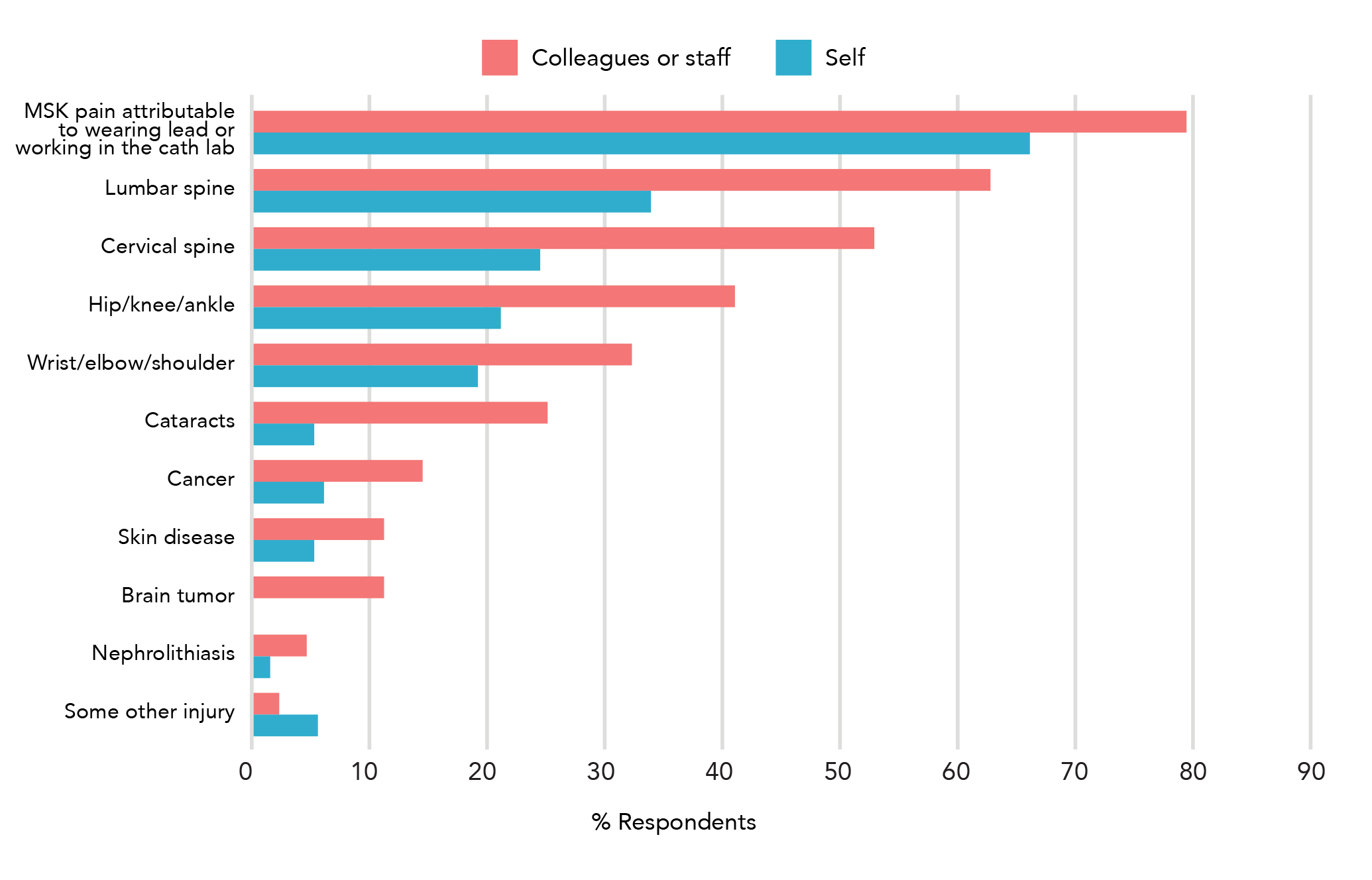
b. Orthopedic issues. Healthcare professionals must wear heavy-weight lead-lined garments, including aprons, hats, glasses, thyroid collars, shields, leg guards, vests and sleeves, that wear on orthopedic musculature.
i. Standard lead aprons can range from 10 to 25 pounds, with many weighing in the 10–15-pound range. Average frontal apron weighs about 8 pounds.
ii. Spine injuries. A recent surveyreported that 342 percent of interventional cardiologists experience lumbar or spine issues.
iii. Pain. In a recent survey, 66 percentof SCAI members report pain in musculoskeletal system2
i. Fluoroscopypractitioners are exposed to an estimated 50 mSv-200 mSv over their career, an estimated equivalent of 25,000 to 50,000 chest X-rays.
ii. Current practicerequires all members of fluoroscopy practices to wear PPE, including lead body aprons and thyroid shields.

1. Lead thickness of 0.5 mm should stop 95% of scatter radiation.
2. Protective integrity must be checked regularly.
3. Conventional lead aprons are being replaced with newer aprons made of lighter materials, including aluminum, antimony, barium, bismuth, tungsten, tin, and titanium.
4. Newer composite aprons use lighter materials but may still pose significant cumulative orthopedic burden to fluoroscopy practice members.

i. Operators: interventional cardiologists, interventional radiologists, electrophysiologists, vascular surgeons, and other physicians who perform fluoroscopy procedures. These operators experience higher exposure levels due to the duration of procedures and lack of upper torso shielding during device cases.
ii. Imagers: radiologists and imaging specialists.
iii. Anesthesiologists: Providers who remain bedside during fluoroscopy procedures, often in the primary radiation field.
iv. Nurses, techs, other fluoroscopy lab personnel: Support team members who experiencecumulative radiation exposure.
vii. Women: Radiation exposure concerns regarding fetal effects. May contribute to lower representation of women in the field.
Economic Effects on Hospitals. The Organization for Occupational Radiation Safety in Interventional Fluoroscopy (ORSIF) estimates the annual economic costs of cancer and orthopedic injuries from chronic radiation exposure is at least $49million in the United States3.
States have begun amending rules to allow enhanced radiation protection systems that reduce orthopedic injury while maintaining radiation safety.
State Reform measures. Michigan, New York, Illinois, and California are leading efforts to modernize radiation safety standards.
Existing Laws and Regulations. 31 states assign oversight to the Dept. of Public Health and 14 states to the Dept. of Environmental Protection. Most states require personnel dose monitoring (48 states), operator training and certification (46) and site-specific safety programs (47). If the reported dose exceeds occupational limits, all states require reporting to the state authority and supervised corrective steps, though often there is lack ofclarity on the specific corrective steps4.
State laws requiring lead aprons. Only 15 states (PA, VA, DE, AL, AZ, AK, OK, MN, TN, CA, NM, ND, MO, SD, SC) specifically require the use of lead aprons rather than allowing any form of barrier protection.
California – Radiologic Technology Certification Committee
Arizona – SB 1121, Link to coalition letter of support
Illinois – HR565
Medicare Conditions of Participation (CoP) are federal health and safety standards that healthcare facilities must meet to participate in Medicare and Medicaid programs. These standards are the foundation for improving quality and protecting the health and safety of beneficiaries.
The CoP requires that radiologic services must be free from hazards for patients and personnel.
The Joint Commission on Accreditation of Healthcare Organizations and the American College of Radiology provide baseline federal oversight, including operator qualifications and continuing education requirements, equipment quality control, patient dose optimization, and safety program requirements5.